"You can't really call it land. It's wetness. It belongs to the river," says Marina Tabassum in an interview with The Guardian about the Ganges Delta in her home country Bangladesh, which is known to be particularly threatened by the effects of climate change.
For most cities in the world, architecture has become a symbol of permanence and stability. But in Bangladesh, especially in the impoverished rural areas of the country, people can lose their livelihoods and homes overnight, and cities and villages can change irrevocably. How can an architect work under such extreme conditions?
The work and life of Marina Tabassum – born in Dhaka in 1969 and currently head of her office in her hometown – provide some answers to this question.
A Career Shaped by Social Responsibility
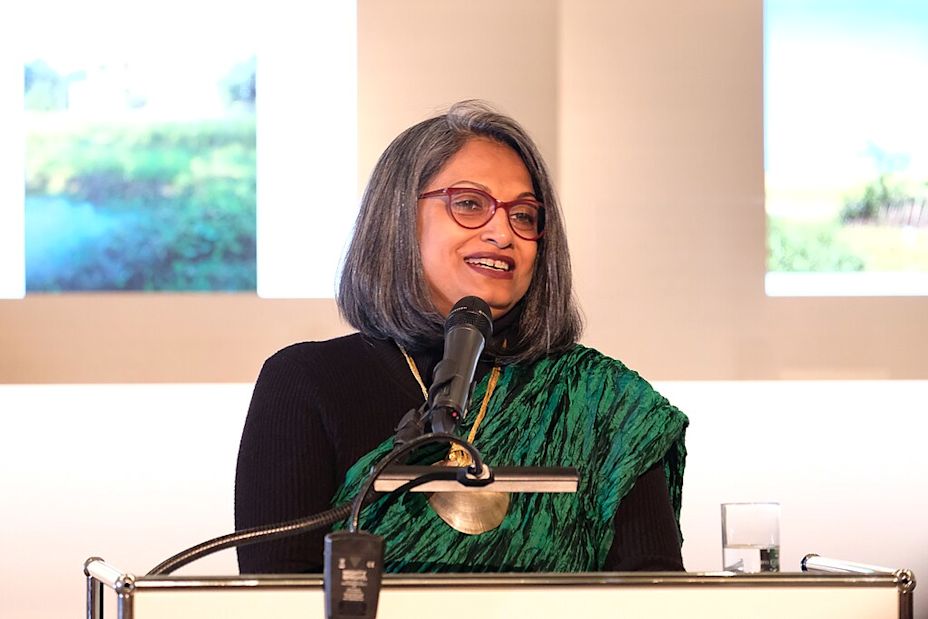
When Tabassum grew up in the war-weary, young Bangladesh of the 1970s, her father was the only doctor in the neighborhood. Every morning, before Tabassum's father left for his clinical work, he took care of the needs of patients from a nearby slum who gathered in a long line in front of the Tabassum family home. This experience prompted Marina Tabassum to work on socially oriented projects that put people at the center and for which she has become world famous.
After graduating from the Bangladesh University of Engineering and Technology (BUET) in 1995, she realized many pioneering projects such as the Museum of Independence, the Independence Monument of Bangladesh, and the Bait Ur Rouf Mosque.
Her innovative and cost-effective approach to humanitarian design has made Marina Tabassum a global architectural icon. Her concept relies on local skills and materials, indigenous knowledge, and quickly erected prototypes of buildings that are in harmony with the cycles of nature.
In 2021, Tabassum was awarded the Soane Medal for Architecture. She is the first architect from the Global South to receive this award. The award recognizes her work as "architecture with relevance," as her sustainable designs are driven by her mission to improve the lives of people with very low incomes in Bangladesh.
"As architects, we have a responsibility to these people," she says. "The construction industry contributes to half of all global emissions, but the people affected by rising sea levels in coastal areas leave no CO₂ footprint at all."
Local Solutions for the "Bottom Percent"
As a young architect witnessing the urbanization boom in Dhaka in the 1990s, Marina Tabassum noticed that all the buildings looked the same. Due to the globalization of architecture, quickly erected buildings made of concrete, aluminum, and glass sprang up everywhere.
The same building could have stood in China, on the Arabian Peninsula, or in Bangladesh. However, Tabassum realized that the standard materials used were poorly suited to certain conditions: concrete does not fare well in a humid climate like Bangladesh. And glass cannot cope with the heat: it turns buildings into greenhouses that require energy-intensive cooling systems.
"The mistake with this kind of architecture is that you bring something from a cold country into a warm country like ours," she told Dezeen.
This idea has had a lasting influence on the work that is especially close to Tabassum's heart. For victims of climate change, for people who are landless or on the run, Tabassum designed the "Khudi Bari," which means "small house." It is a modular shelter to protect against monsoon rains, which can be assembled and disassembled by hand in no time. A "Khudi Bari" is made of bamboo and local materials and costs only 300 GBP.
Tabassum admits that it is difficult for an architectural office to make ends meet if it focuses exclusively on low-cost solutions. That is why she still takes on selected commercial and private projects to finance her passion for humanitarian architecture.
However, she believes that architecture and good design should not only benefit influential population groups with high incomes. Tabassum points to the global gap between rich and poor and adds: "It is not sustainable if we only take care of the one percent. We have to do more."
dormakaba Editorial Team

Related articles
Society
Green Beyond the Pitch: How Next-Gen Stadiums Seek Carbon Neutrality
Major leagues and international sports organizations are already incorporating environmental objectives into their development strategies. And more and more stadium projects are conceived from the outset as green sports venues — facilities designed to minimize their environmental impact across their entire life cycle.
Architectural Elements That Changed History
The Framing: Above and Below
Architectural Elements That Changed History
The Flying Buttress: The Art of Support