The new normal in construction: Five disruptive developments in focus.
The construction industry remains one of the least digitized sectors worldwide. The comparatively low level of digitization in this area is one of the reasons for poor decision-making and inefficient processes, which drive up costs and harm the environment. Budget and schedule overruns are almost the norm in the construction industry. According to McKinsey, the completion of large projects typically takes 20 percent longer than planned and exceeds the budget by up to 80 percent. However, even though the industry is moving relatively slowly towards "Industry 4.0," some progress in digitization can be observed.
The COVID-19 pandemic is likely to have further advanced the debate on digitization in construction, as it forced many industry leaders to rethink and reflect on the previous way of building. With the help of AI, drones, 3D printing, prefabrication, or other means, the automation and digitization of various processes could thus usher in a new era of construction. But how will the effects of the pandemic, combined with the latest innovations, shape this new era? What will the resulting " new normal" of construction look like?
From sustainability to standardization, we have analyzed five disruptive developments in construction that should be kept in mind.
1. Faster Change in the Industry
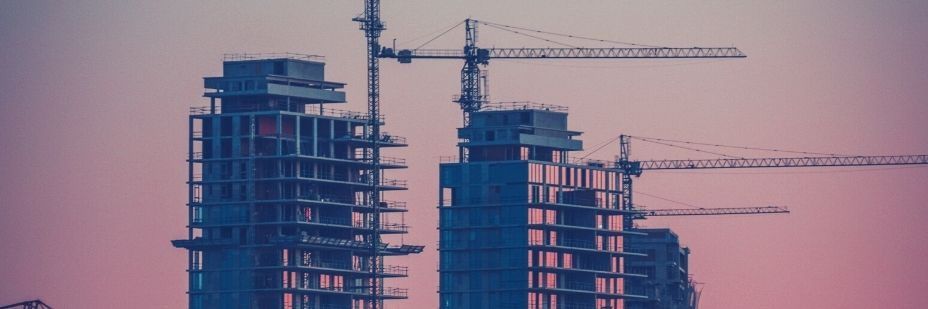
It cannot be denied: the pandemic has burdened the construction industry, just like many others. A part of the companies in the construction industry had to accept losses in revenue or shut down part of their operations during the course of the pandemic. However, many experts believe that there is a silver lining, as the pandemic has also provided new impetus for a technological advancement of construction processes that are suitable for accelerating previously notoriously slow construction processes. All stakeholders must now prepare for a fundamentally different new normal and changes to the entire industry due to this accelerated change, advises a new McKinsey report.
Although much of this transformation is driven by digitization and technological progress, that is not all. The McKinsey report also highlights that all players, large or small, will experience a significant restructuring of the entire industry. Increased M&A activity and many new and interesting start-ups entering the industry will mark the beginnings of this new normal in construction.
As new, emerging companies establish themselves, existing companies must rethink and reinvent their business models, products, and services to remain competitive and relevant in the new normal.
2. Sustainability
The low level of digitization in the construction sector goes hand in hand with the industry's poor reputation in terms of sustainability. Inefficient construction processes are both a cause and a consequence of the fact that the construction sector is one of the largest polluters: Although estimates vary, some claim that the industry is responsible for 23 percent of air pollution, 50 percent of carbon dioxide emissions, 40 percent of water pollution, and about half of all waste generated. Industry leaders are aware that this must change.
The construction industry is only at the beginning of its sustainable development and still has a long way to go. Nevertheless, the increasing emergence of ecological efforts paving the way for green innovations will continue to transform the industry for many decades to come.
From planning to supply chain management, all phases of this complex business sector will continue to change—always taking into account the environmental impact of buildings throughout their entire life cycle. Stricter government regulations and requirements worldwide, advancing digitization, more efficient building materials, and consumer demand for more environmentally friendly behavior will continue to drive these developments.
3. Automation of Workflows and Services
The automation of products, processes, and services will probably be one of the most transformative side effects of advancing digitization in construction. The pandemic has only made the possibilities clearer: Thanks to the increasing spread of technologies such as BIM, 3D printing, robots, drones, AI, and analytics, it is becoming possible to carry out an ever-increasing proportion of construction work off-site.
Automation in the construction sector, which is characterized by complex cooperation and workflows, will mainly offer opportunities for change in the three areas below:
Automation of physical labor on site
Automation of production and manufacturing (e.g., 3D printing of building components in factories)
Automation of services and management processes (e.g., design, planning, or facility management)
Overall, this will reduce on-site work and make administration significantly more efficient.
4. Specialization and Customer Orientation

"The riches are in the niches," claims a well-known marketing saying. With the increasing demand for customized services and the higher standards of our time, construction is no exception. For the customer base that values a high level of experience, the new normal in construction will be characterized by increasing specialization of products and services.
Whereas previously a "winner-takes-all" situation dominated the markets, demand for precise specialization and expertise is currently increasing. Companies that specialize in certain products and segments, such as luxury single-family homes, hospitals and medical facilities, or manufacturing plants, will improve their profit margins and competitive advantages. Likewise, companies that focus on specific services and products can expect a smaller but more loyal and regular customer base. Therefore, a high level of customer orientation will be crucial for the chances of those companies that want to remain successful and profitable.
The good news is that thanks to new training and further education methods and opportunities, it will also be easier for personnel to qualify and specialize in newly emerging subfields to meet market demand.
5. Globalization and Standardization
The increasing specialization in terms of products and services by no means implies that companies will operate locally and become smaller. On the contrary: with a consolidated value chain, automation, and globalized codes of conduct, the construction ecosystem in the new normal will be more international than ever.
In response to the challenges of climate change, in healthcare, and regarding the real estate crisis, there will be stricter international laws, regulations, and health protection and occupational safety measures. Especially in industrialized nations, governments and associations see the need to standardize building codes and create certification and approval procedures for factory-made products, instead of inspecting each individual production facility.
As standardization becomes the new normal in construction, market entry barriers for globally operating companies decrease. With a growing number of cooperation opportunities and innovative supply chains, the construction industry also has the chance to truly operate internationally.
New Normal for Sustainable Growth Opportunities
Thanks to all these upheavals brought about by advancing technologies and a changing market dynamic, the new normal in construction will undoubtedly be less burdensome for the planet and people—and certainly more efficient.
With digital, sustainable, and customer-oriented business strategies, forward-looking companies will be able to use the changes for their further development.
dormakaba Editorial Team

Related articles
Architectural Elements That Changed History
The Framing: Above and Below
Architectural Elements That Changed History
The Flying Buttress: The Art of Support
Architecture
Jugendstil: the German Interpretation of Art Nouveau
Jugendstil was not merely a branch of Art Nouveau but a reinterpretation deeply grounded in German culture. The term comes from “Jugend,” a Munich-based magazine founded in 1896 that quickly became a cultural hub for young creatives. It promoted innovative ideas in architecture, the decorative arts, and graphic design, standing in opposition to the traditional academic historicism that dominated the period.