Revolving doors represent a particularly suitable solution for managing accessibility in public buildings. They offer a very high level of security, improve the energy performance of infrastructures, and help streamline the flow of visitors.
Managing Building Access with Revolving Doors
Revolving doors are access solutions designed to meet several objectives: managing visitor flow, providing a high level of security, and improving energy performance. They are also an aesthetic choice particularly suited to buildings open to the public.
A Variety of Models
There are several models of revolving doors, with different heights, widths, and rotation speeds. They can have 3 or 4 wings to adapt to the specific uses of these infrastructures.
The most common model is the three- or four-wing revolving door. It can include several options: manual, automatic, and others. This makes it a versatile model suitable for different needs.
Certain models are designed to enhance the aesthetics of buildings thanks to an elegant and lightweight design. The KTV Atrium Flex revolving doors are an excellent choice in this regard.
Revolving doors are the best solution for managing the accessibility of building entrances that are open to the public, whether for multinationals, companies, offices, shopping centers, airports, or even industry-related infrastructures.
Managing Large Flows Thanks to High-Capacity Revolving Doors
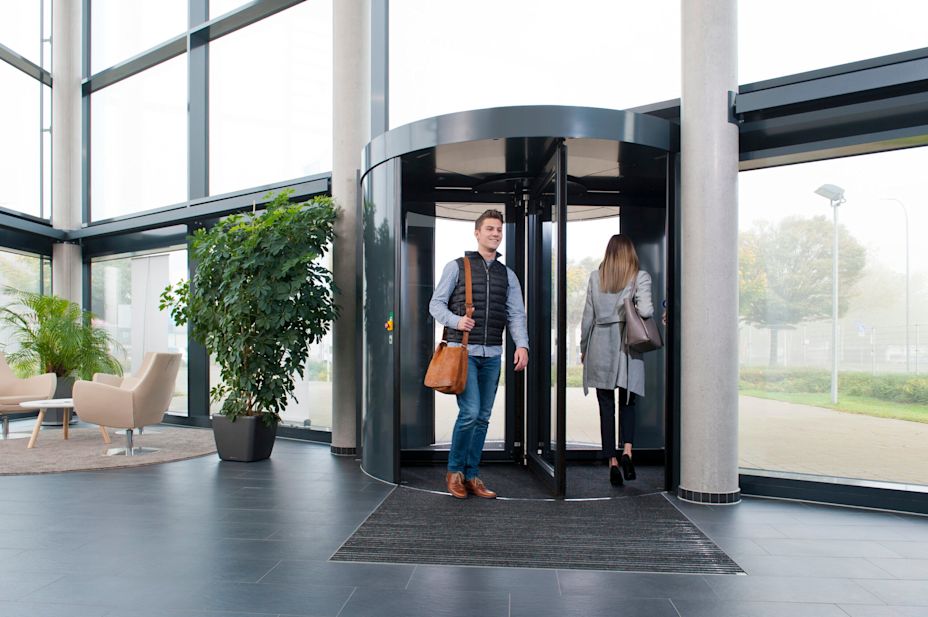
Certain sectors face significant visitor flows. This requires good management to improve the user experience for the public.
The high-capacity revolving door is the most effective solution for managing large numbers of visitors. These models are designed to allow people to pass through more quickly and in greater numbers. This helps avoid congestion and streamlines movement.
For managing the flow in high-traffic buildings, the KTC Comfortline revolving doors are the most suitable.
Better Comfort for Visitors
Revolving doors are designed to eliminate drafts in order to maintain a pleasant climate and a constant temperature inside the infrastructures.
The structure of these doors is designed to limit air exchange between the inside and outside during visitor passage. This offers undeniable advantages for air-conditioned or heated spaces: temperature changes are limited for better visitor comfort.
Limiting air exchange improves the energy performance of buildings. Less energy is needed for heating or cooling spaces. Revolving doors are a functional, aesthetic, practical, and ecological choice.
Secure Management of Building Accessibility
Reliability is one of the main strengths of revolving doors. They are able to operate optimally in all situations. This provides a very high level of security for users. In addition, they are equipped with systems such as motion sensors and emergency systems in case of breakdowns to handle unforeseen events.
Revolving doors are perfectly suited to establishments requiring access control to specific areas. Models such as security revolving doors and single-person airlocks include systems designed to manage controlled physical access.
For protecting restricted areas, the Geryon security revolving doors and turnstiles are the most suitable. They offer multiple options to provide different levels of security. Monitoring can be ensured by a weighing system or sensors, and operation can be triggered by badges, codes, a button, or biometric identification systems. Highly resistant, this solution includes bulletproof, burglar-resistant finishes and fire-resistant closure.
For the protection and management of access to sensitive areas, the Orthos single-person airlock is the best choice.
An effective solution with multiple advantages, the revolving door is the wisest choice for managing visitor flow. A wide range of models is available to meet all needs and improve comfort, security, and access management performance.
dormakaba Editorial Team

Related articles

Architecture
The Five Most Beautiful Contemporary Universities in the World
Education is not only about teaching—it is about how we teach. The quality of the learning experience shapes both individuals and societies, influencing how we think, live, and engage with the world. While excellent programs, teachers, and content are essential, other elements also deeply affect the educational process. Among them, beauty.

Security
The Role of AI in the Security Operations Center
Artificial Intelligence has emerged as a key lever to enhance SOC performance, enabling teams to manage the scale and complexity that conventional tools can no longer handle effectively.
Security
The Invisible Perimeter: Rethinking Stadium Access Control
The sports industry has been grappling with this tension between protection, technology, and spectator experience for years. A study drawing on the views of more than 150 security managers at sports venues across the United States identified the most pressing challenges they face: managing access flows, coordinating increasingly integrated technology systems, and the constant pressure to reduce wait times.