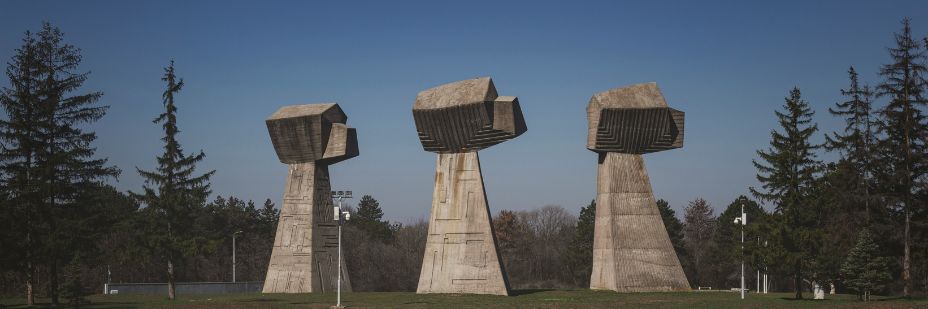
Gigantic concrete flowers, sculptural wings, shapes that seem to have landed from another planet and remained in the middle of woods and hills. Those who encounter them for the first time often mistake them for sets from a science fiction film. In reality, they are modernist memorials, built to commemorate some of the most dramatic events in twentieth-century European history.
The Spomenik are fascinating monoliths that blur the line between sculpture and architecture. Also, ideal destinations for those who love to travel, photograph, and seek out places well off the beaten path.
Spomenik: What It Means and Where the Term Comes From

“Spomenik” simply means “monument” in Serbo-Croatian and Slovenian. In common usage, however, it now refers to a specific category: the brutalist memorials built in socialist Yugoslavia between the 1960s and 1980s.
The person who gave them new international visibility was Belgian photographer Jan Kempenaers, who traveled through the former Yugoslavia between 2006 and 2009 to document them, collecting the images in the book Spomenik (Roma Publications, 2010). American researcher Donald Niebyl also played a decisive role as the creator of the Spomenik Database, an online archive cataloging these monuments with detailed records, maps, and historical materials which later became a publication in its own right.
A small paradox: it took an outside eye to transform a heritage that had long remained nearly invisible into a global phenomenon.
Why They Were Built: A Political and Cultural Project
To understand the Spomenik, you have to start with history. During the Second World War, Yugoslav territory was the scene of brutal battles, occupations, concentration camps, and mass killings. But also of fierce partisan resistance.
After the conflict, Yugoslavia under Josip Broz Tito built its identity around that memory, anchored in the ideal of “brotherhood and unity” among its different peoples. The memorials were meant to honor the victims of fascism and the partisan struggle, while also holding together a young and complex nation. Following the break with Stalin in 1948 and the choice of a non-aligned “third way,” Yugoslavia rejected Soviet-style socialist realism in favor of a modern, abstract visual language open to international experimentation.
Where other regimes celebrated power through heroic statuary, Yugoslavia chose sculptural and symbolic forms capable of speaking to everyone without prescribing a single narrative.
How They Are Made: Materials, Shapes, and Landscape

Concrete, stainless steel, stone: the materials are those of modernism and Brutalism, deployed with surprising expressive freedom.
The shapes are abstract but never arbitrary. They grow from wings, flowers, fractured rock, spirals, volumes opening toward the sky. Each monument does not teach but rather suggests an idea: resistance, grief, rebirth.
Another defining characteristic is the relationship with the surrounding landscape. Many Spomenik stand on the very sites of the events they commemorate and are designed to be traversed, not merely observed. Several complexes incorporated museums, amphitheaters, parks, and spaces for public ceremonies. These were places of memory but also of collective life: commemorations, public gatherings, and school visits helped transmit the history of the war and the Resistance to new generations. At some sites, such as Kozara, the scale of celebrations and visitor numbers reached remarkable dimensions.
Why the Spomenik Still Matter to Designers Today
For architects and designers, the Spomenik offer a genuinely valuable case study. They demonstrate how a humble material like concrete can become a full expressive language, how space can carry memory without resorting to rhetoric, and how the relationship between a work, its landscape, and the people who inhabit it is an integral part of any design.
They are also an example of how the conservation of modern heritage remains an open challenge: how do you protect architecture built to endure but left exposed to neglect? Above all, they are a reminder of the fact that built space is sometimes the most direct means we have of not forgetting.
Spomenik Worth Knowing
Jasenovac - Croatia
Built on the site of the concentration camp of the same name — where tens of thousands of people lost their lives between 1941 and 1945 — the “Stone Flower” rises roughly 24 meters above the plain along the Sava River. Designed in 1966 by Bogdan Bogdanović, one of the most significant Yugoslav architects of the postwar period, the memorial abandons all celebratory rhetoric in favor of a deeply symbolic language. The reinforced concrete is shaped like an opening flower, its petals clean and precise, simultaneously fragile and imposing. The empty landscape amplifies the effect: visible from a great distance, the work becomes, in this setting, a powerful gesture of rebirth.
Tjentište - Bosnia and Herzegovina
The memorial from 1971 is the work of sculptor Miodrag Živković. Two large concrete wings, approximately 19 meters high, suggest the two halves of a split rock. The gap between them symbolically evokes the partisan breakthrough of enemy encirclement during the battle of 1943. The rough, sculpted surfaces — bearing the traces of construction — enter into dialogue with the surrounding rock faces, making the monument appear to belong to the mountain rather than to human hands.
Petrova Gora - Croatia
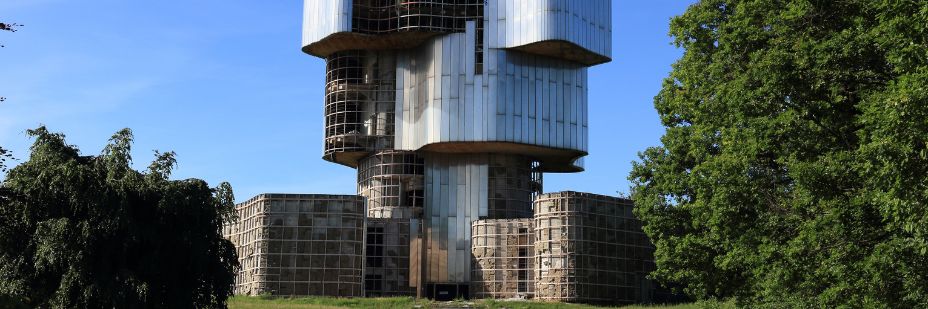
On the hills of the Kordun, the monument to the Kordun and Banija Uprising is the story of a lost beauty. Sculptor Vojin Bakić conceived it in the early 1980s as a large curved mass, more than 30 meters high, clad in polished stainless steel panels. In sunlight, the metal mirrored the sky and the surrounding forest; inside, exhibition spaces were dedicated to the Resistance. Over the years it has sustained serious damage and looting, and has become one of the emblems of the abandonment that has befallen many Spomenik.
Kosmaj - Serbia
Five large concrete “wings” — rhythmic and geometric — rise on the slopes of a hill not far from Belgrade. The 1971 design by Vojin Stojić and Gradimir Medaković is dedicated to the fighters of the local partisan detachment. The exposed concrete, with its sharp lines and acute angles, reads alternately as wings, blades, or flames. Conceived to be seen from a distance and experienced up close, it remains a popular excursion destination for residents of Belgrade. An effective demonstration of how abstraction and landscape can merge into a single composition.
Ilinden (Known as Makedonium) - North Macedonia
Monument or spacecraft? On the hill of Mečkin Kamen, above the town of Kruševo, the Makedonium (1974) looks like something that has landed from above the valley. Created by the artist couple Jordan and Iskra Grabulovski, it commemorates the 1903 Ilinden uprising against the Ottoman Empire and the short-lived Republic of Kruševo. The spherical form, composed of curved concrete volumes, conceals a bright, walkable interior where light filters through shaped apertures.
Podgarić - Croatia
The interplay of materials is the defining feature of this 1967 memorial, dedicated to the Revolution of the People of Moslavina. Sculptor Dušan Džamonja set large wing-like concrete forms in dialogue with a circular element clad in aluminum, which appears to detach itself from the gray mass. The result is a monumental sculpture of near-total abstraction that emerges from the hilly landscape and shifts in appearance with the light and the sky.
After Yugoslavia: Abandonment, Contested Memory, and New Attention

With the dissolution of Yugoslavia in the 1990s and the wars that followed, many Spomenik lost the purpose for which they were built. Some were damaged or vandalized; others were simply forgotten, in a context where the memory of the Second World War was no longer shared as it once had been.
Today the picture is more complex. Some monuments have been restored or returned to active commemoration, while others remain in fragile condition. The exhibition “Toward a Concrete Utopia: Architecture in Yugoslavia, 1948–1980,” organized at MoMA in New York in 2018, brought Yugoslav architecture into the global conversation and helped renew attention to the issue.
There is, however, one point worth keeping in mind — perhaps the most important lesson for those who approach these works as designers or researchers: seeing the Spomenik only as “strange, photogenic structures” means losing half their meaning. They are works created to tell a story, often a painful one, and must be read in relation to the context that produced them.