These five buildings withstand earthquakes by swaying.
Dozens of buildings were destroyed when a devastating earthquake shook Mexico City in 2017, but its gleaming Torre Reforma suffered only a few cracks and withstood the quake. It is often said: “Earthquakes don’t kill people, buildings kill people.” In earthquake-prone countries like Mexico and Japan, engineers use a mix of time-tested and cutting-edge techniques to ensure that structures hold up. Constructing buildings on, for example, giant shock absorbers, sliding pendulum or rubber bearings, or on deeply anchored, flexible foundations and robust steel skeletons can help reduce the impact of strong seismic shocks and thus make a building earthquake-proof.
Earthquakes threaten—statistically speaking—a third of the world’s population and are considered the most expensive natural disasters—not only in terms of economic damage. Rebuilding is often simply not possible for various reasons, and a fresh start is rarely an option for those affected. From Christchurch to Istanbul, at-risk cities are therefore upgrading on a large scale. But even simple measures, such as the use of seismically resistant glass fibers or earthquake-proof access systems, can be very helpful by helping to reduce injuries or contribute to rapid evacuation.
The five architectural masterpieces described below are setting new global standards in terms of earthquake risks—both regarding building safety and the safety of cities, and thus future security in general.
TAIPEI 101, TAIWAN

Taipei 101 has a secret recipe for safety—a giant steel ball that swings like a pendulum to balance out shocks in the event of an earthquake or typhoon. The 660-ton ball, with a diameter of 5.5 meters, is suspended in the upper floors of the pagoda-shaped skyscraper and is a tuned mass damper. It is intended to protect the 508-meter-high tower, which is only a few hundred meters from a tectonic fault line, from extreme swaying. Dozens of steel supports and eight concrete-filled mega-columns inside Taipei 101 form a stable frame, whose rigidity is achieved by cross and longitudinal bracing. The engineers reinforced the foundation by driving hundreds of piles deep into the ground. They are confident that Taipei 101 could withstand even the strongest earthquake to hit Taiwan in the last 2,500 years.
TORRE REFORMA, MEXICO CITY

In Mexico City, it is crucial to ensure that new skyscrapers are built to be earthquake-proof, as the city—founded by the Aztecs and built on the muddy ground of a dried-up lake—is particularly susceptible to seismic shocks. The triangular Torre Reforma, located on one of the city’s most important boulevards, resembles an open book in shape—thanks to its two concrete and one glass façade—and is designed to move. The glass fronts have flexible hinges with crumple zones, allowing them to shift during a quake. Movable joints in the concrete exterior walls of the 246-meter-high tower help largely prevent cracking. The two façades made of massive concrete walls are also anchored sixty meters deep in the granite ground to give the design by architect L. Benjamin Romano stability. According to the engineers, simulated tests show that Torre Reforma could withstand any earthquake for the next several millennia.
SABIHA GÖKCEN TERMINAL, ISTANBUL
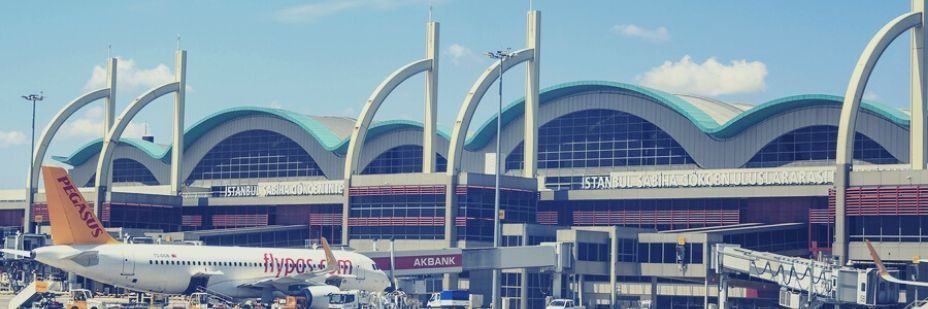
The Sabiha Gökcen Airport Terminal in Istanbul is considered the largest earthquake-proof building in the world, covering an area of almost 400,000 square meters. It can withstand a quake of up to 8 on the Richter scale. The terminal is located in the seismically active zone where the 1999 Izmit earthquake killed over 17,000 people. It stands on hundreds of energy-absorbing isolators that separate it from the ground, reducing potentially devastating lateral forces by up to 80 percent. Developed by Arup, the entire building moves from side to side to limit damage and protect passengers. Through testing, engineers have ensured that the structure can withstand up to fourteen earthquake scenarios.
TRANSAMERICA PYRAMID, SAN FRANCISCO

The devastating 1989 Loma Prieta earthquake was a test for the shock-resistant construction of the 48-story landmark. It shook and swayed for a minute but remained undamaged. Designed as a pyramid, whose shape allows daylight to reach the streets at the base of the building, the large-scale base structure gives the construction high stability. To limit the extent of displacement and shaking during a quake, engineers used a unique truss system. The steel and concrete foundations reach fifteen meters deep into the underlying rock and move with the horizontally acting forces generated by the quake. On the outside, steel rods on every floor reinforce the prefabricated quartz-coated exterior.
FA-BO, NOMI CITY
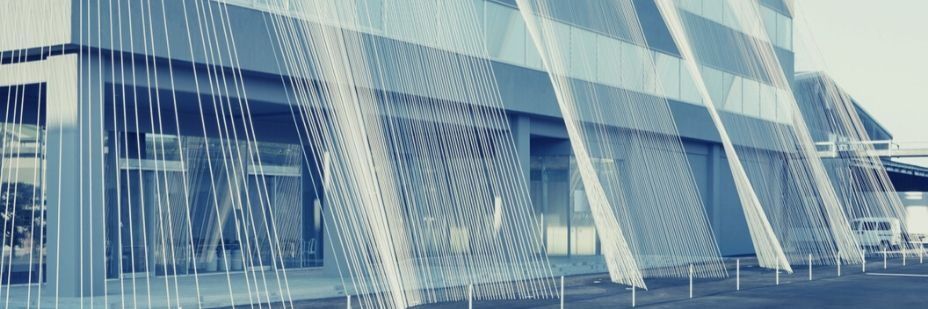
The Japanese Fa-Bo building, wrapped in a lightweight curtain of thermoplastic and carbon fiber rods, may look as if it has been attacked by Spider-Man, but the high-tech system resists earthquakes and tsunamis. The design by architect Kengo Kuma turns many earthquake-proof plans on their head by focusing on strengthening the outer building shell instead of the building core. The thermoplastic carbon fiber composite that anchors the three-story concrete building is much stronger and lighter than steel and was angled over the façades for lateral loads. It is new for carbon fibers to be used for earthquake-proof constructions—in a country with 1,500 quakes per year, truly a test of endurance.
dormakaba Editorial Team

Related articles
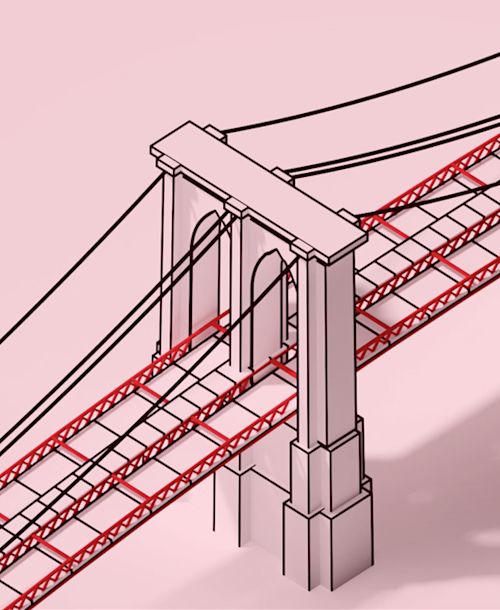
Architectural Elements That Changed History
The Framing: Above and Below
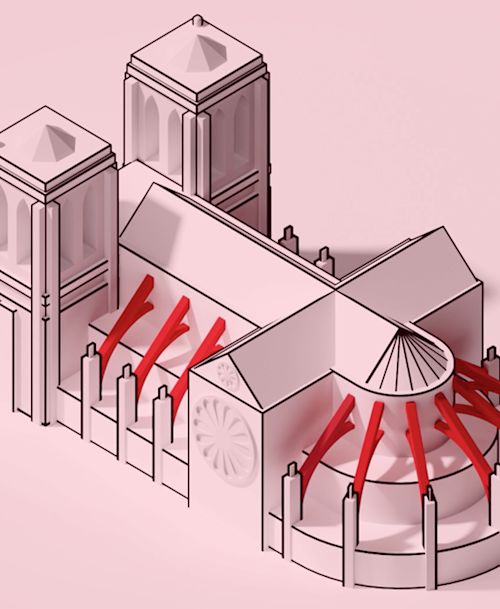
Architectural Elements That Changed History
The Flying Buttress: The Art of Support

Architecture
Jugendstil: the German Interpretation of Art Nouveau
Jugendstil was not merely a branch of Art Nouveau but a reinterpretation deeply grounded in German culture. The term comes from “Jugend,” a Munich-based magazine founded in 1896 that quickly became a cultural hub for young creatives. It promoted innovative ideas in architecture, the decorative arts, and graphic design, standing in opposition to the traditional academic historicism that dominated the period.