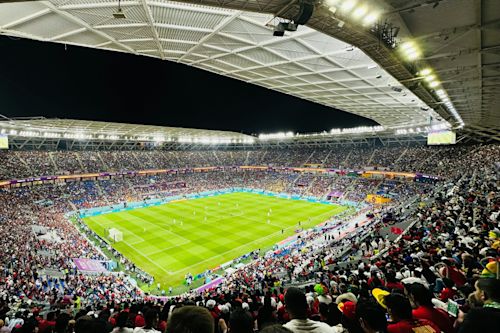
For decades, stadiums were designed with a very specific goal: to host sports competitions. But this model focused exclusively on matchday now faces increasing economic and urban pressure. The reason is pretty straightforward: these are extremely expensive infrastructures that generate activity only intermittently.
At the same time, the cost of these megastructures has continued to grow. SoFi Stadium in Los Angeles, which hosted matches at the 2026 FIFA World Cup, is a paradigmatic example: its construction exceeded $6.8 billion, a record figure that leads a long list of escalating expenditures.
Part of these investments also comes from public funds. Between 1970 and 2020, state and local governments in the United States and Canada allocated approximately $33 billion to build stadiums for major league teams. These figures reflect the extent to which stadiums have become urban megaprojects and have fueled a broader debate about their real profitability.
Beyond the ‘Matchday’ Model

Several studies conclude that the construction of professional stadiums does not always generate any significant economic growth or boost local employment. In some cases, cost-benefit analyses even suggest negative returns. This evidence has opened a wider discussion about whether stadiums should be understood solely as sports infrastructures or, going a step further, as tools for urban development.
The low frequency of use affects not only the economics of these projects, but also their energy and operational efficiency. A high-capacity stadium can consume tens of thousands of kWh during a single event, between lighting, air conditioning, and spectator services. When a venue sits largely empty for most of the year, it becomes too expensive: maintenance costs remain high while effective utilization stays low.
Faced with this reality, the sector is evolving toward a new model: stadiums designed to operate all year round.
Design Flexibly From the Ground Up

The answer to these challenges lies in design. New projects are embracing more flexible and adaptable stadiums — venues capable of hosting different types of events without major structural interventions or an expanded urban footprint.
These hybrid systems combine permanent premium zones with retractable sections for general admission. This results in greater operational efficiency: some studies indicate that this type of design can increase annual utilization from 62% to 89%, while reducing energy costs by around 18%.
At Atlanta's Mercedes-Benz Stadium, for example, modular seating allows the venue to host 34% more non-sporting events annually, generating $2.1 million in additional concession revenue in a single year.
Lightweight and Modular Structures
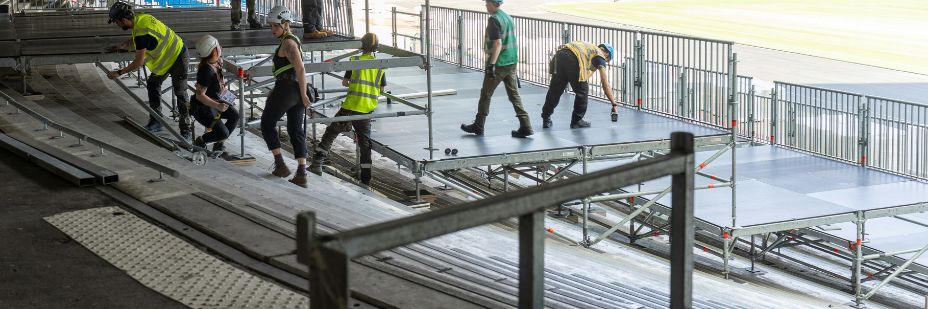
Engineering has evolved alongside design. Aluminum and lightweight steel structures used in retractable stands can reduce structural load by up to 40% compared to fixed seating. Automated systems now allow entire sections to be reconfigured in as little as three hours, a significant improvement over the lengthy operations required by traditional models.
Many modern stadiums also incorporate movable architectural elements — such as retractable roofs or sliding pitches — that make it easy to switch quickly between different event formats.
Flexibility extends to temporary solutions as well. Prefabricated bleachers can be installed or removed according to demand, allowing a venue's capacity to increase by 15% to 20% without expanding the permanent structure. These systems also reduce material waste during construction and speed up assembly times.
Hybrid Programming: Concerts, Conferences and Beyond
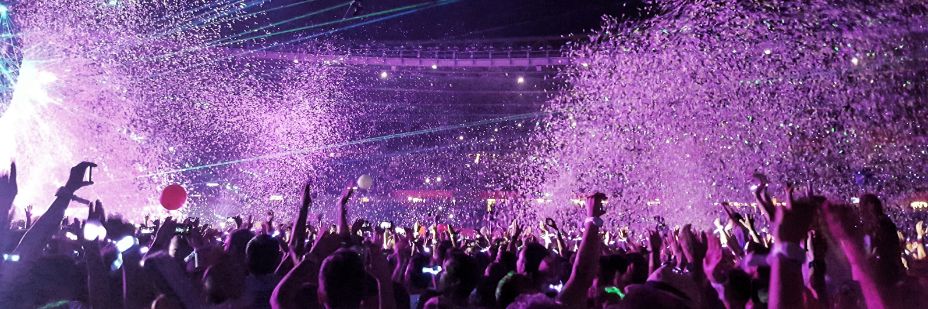
The architectural evolution is accompanied by a shift in programming. Stadiums are no longer conceived solely as sports facilities, but as platforms for entertainment and broader urban activity.
Many modern venues incorporate dedicated infrastructure for non-sporting events from the outset: convertible hospitality areas, conference rooms, exhibition spaces, and logistics access points adapted to large productions.
For this hybrid programming to work, the technical design of the stadium must accommodate different formats. Acoustics, for example, have become a critical element. Sound treatment systems and reflective panels improve audiovisual quality for concerts and live shows, reducing the reverberation typical of large open structures.
Planning the back-of-house areas is equally essential: logistics zones that allow truck access, stage assembly, and technical management without interfering with the audience experience.
Stadiums Open to the Community
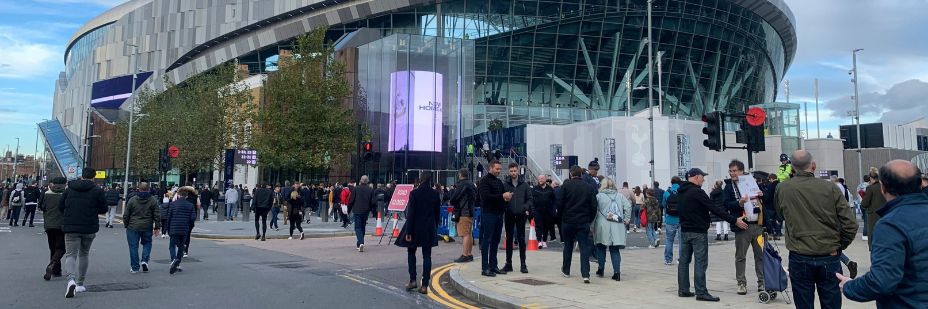
Beyond major events, many stadiums are embracing community-oriented programs — grassroots sports activities, cultural fairs, and educational initiatives.
The goal is to strengthen the relationship between the stadium and its urban environment. When these venues are perceived as open and accessible spaces, they are more likely to earn long-term social support and civic legitimacy.
In many cities, stadiums are transitioning from isolated infrastructures to anchors of urban development. When integrated into broader planning projects, they can act as catalysts by attracting investment, revitalizing neighborhoods, and generating new public spaces. Contemporary stadiums are increasingly designed as urban hubs capable of diversifying economic activity well beyond match days.
The Stadium as the Center of the Urban Ecosystem
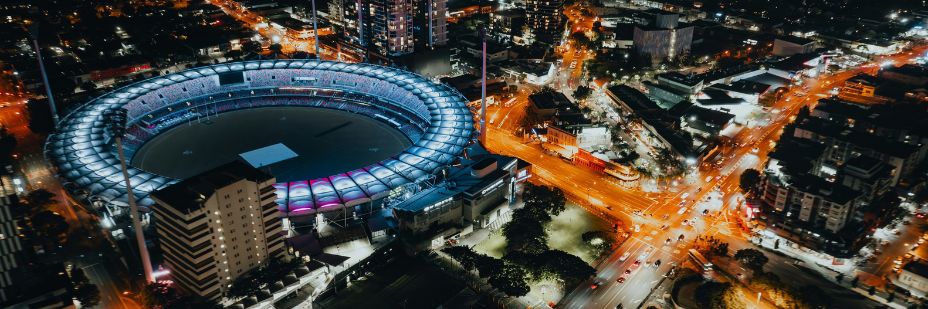
This approach has given rise to mixed-use districts built around sports facilities, where the stadium functions as the centerpiece of a broader urban ecosystem.
A prominent example is the Hollywood Park development surrounding SoFi Stadium in California. The project includes more than 280,000 square meters of offices, 3,000 homes, hotels, retail spaces, and public parks, alongside venues for concerts and cultural events. In total, the master plan envisions investments exceeding $5 billion.
In Europe, Tottenham Hotspur Stadium offers another compelling case. The venue, with a capacity of 63,000 spectators, is part of an extensive urban regeneration program in north London. The stadium — inaugurated in 2019 — is estimated to generate around 402 million euros per year in economic value for surrounding districts, compared to the 140 million attributed to the former White Hart Lane. Its activity is also estimated to support 3,700 full-time equivalent jobs.
The club can host up to 30 non-football events per year, including concerts, boxing matches, and NFL games. Those side activities generate approximately 64 million euros annually, a revenue stream that did not exist under the previous model.