The coronavirus pandemic has changed the world as we know it, both in the short and long term. With millions of people staying at home to get the further spread of the infection under control, hardly any industry has been as strongly affected by COVID-19 as aviation. Between the end of March and April 2020, more than 20 major airlines completely suspended their operations. While some are resuming activities in the form of domestic flights with limited frequency, the question remains whether air travel will ever be the same after COVID-19?
Block
Countless aviation experts worldwide predict that COVID-19 will drive some irreversible changes in air travel in two respects: touchless travel and digitalization.
Although these developments have been underway for a long time, the pandemic is accelerating the natural process of technological development in air travel.
Touchless Travel to Protect Health

From the elimination of handshakes as greetings to the rise of remote work, COVID-19 single-handedly changed all behaviors and attitudes regarding touch and physical contact overnight. The virus can also spread via surfaces, and could therefore, quite literally, “travel along” during flights. For this reason, every touch and all physical contact must be minimized at every stage of a flight, even with the already existing and strict hygiene regulations that must be observed.
Reducing touchpoints in all processes related to air travel is a complex process. It requires many different steps and improvements throughout the airport and aircraft environment—from catering to the gates. One of the most important is touchless access.
Facilitated by biometric and facial recognition technologies, self-boarding gates will not only reduce manual operation—and thus touchpoints—but also security checkpoints and queues at immigration. While state-of-the-art, forward-thinking airports like Singapore and Las Vegas have been using these technologies for a long time, after COVID-19, touchless access will likely become everyday normality in air travel.
Automation and Self-Services Will Dominate Air Travel After COVID-19
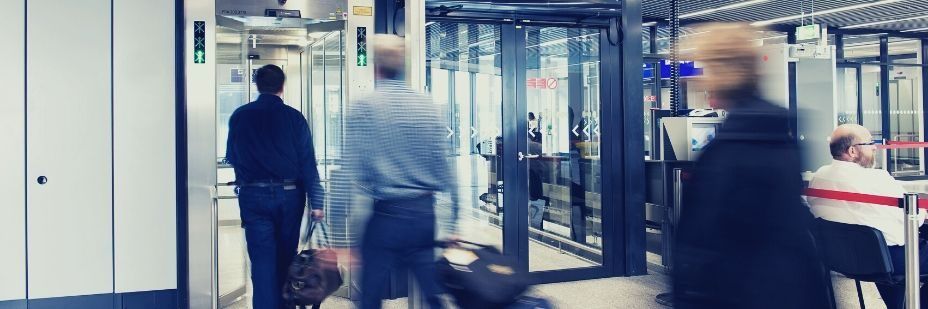
Millions of passengers will scan their documents, provide their biometric data, and proceed to their gates to board their flights.
In order to implement more and more touchless processes, digitalization is advancing massively in all areas related to air travel. Many companies and governments have already taken steps toward digitalization and automation of the travel industry, but after COVID-19, air travel will experience an additional, strong technological boost.
According to Alex Dichter, Senior Partner at McKinsey & Company, the collection of data and its traceability will be crucial for resuming normal operations in air travel while ensuring the safety and quality of services.
Airlines will use this opportunity to accelerate self-services. This is a trend that has been observed for some time, but airlines were probably less quick to roll out these technologies than many customers would have liked.
Alex Dichter, Senior Partner at McKinsey & Company
From Cloud to Cloud: The Triumph of Digital Travel
The possible applications of automation and digital technologies in air travel after COVID-19 seem almost limitless. In addition to touchless biometric applications, some of them could also include digital health passes and software for contact tracing.
The World Economic Forum is already working on a “Known Traveller Digital Identity.” It describes this project as “an initiative that brings together a global consortium of individuals, governments, authorities, and the travel industry to enable safe and ‘seamless’ travel.” In this way, travelers, after agreeing to share their health data, give authorities the opportunity to conduct risk assessments and thus contribute to global health.
All in all, automation and technological improvements in air travel are ready to enhance the flight experience—even after the current COVID-19 pandemic subsides.
dormakaba Editorial Team

Related articles

Society
Green Beyond the Pitch: How Next-Gen Stadiums Seek Carbon Neutrality
Major leagues and international sports organizations are already incorporating environmental objectives into their development strategies. And more and more stadium projects are conceived from the outset as green sports venues — facilities designed to minimize their environmental impact across their entire life cycle.

Technology
Next on AI: A Human and AI Collaborative Future
To move forward with innovation, the next steps will depend on building trust, setting clear limits and strengthening AI collaboration by ensuring everyone takes accountability and follows the rules. The main question now is, how can companies work with AI systems that are strong and safe enough to help them make real-world decisions?

Technology
Next on AI: The Awakening of Recursive Meta-Cognition
Meta-cognition is the process of monitoring and controlling one's thoughts. In AI research, this theory is becoming more linked to systems that check their own competency and adapt their strategy when situations change. In that way, recursive meta-cognition is a loop that repeats itself.