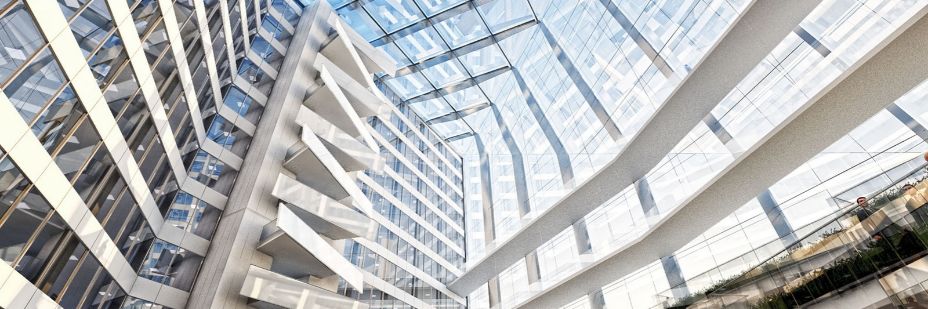
Smart building expert Erik Ubels was a visionary behind The Edge, an Amsterdam office hailed as among the world’s most connected and sustainable upon its completion in 2014.
Ubels was then a CIO at Deloitte, the building’s primary tenant. The Edge’s features, such as an app optimizing how people find parking spots and desks, solar panels to reduce electricity consumption, and sensors that control lighting, pushed the boundaries of smart design at the time.
Ubels, who now consults in the smart building space, spoke with the dormakaba Blog about that project and how the landscape has changed since then. His responses have been edited for length and clarity.
dormakaba: What was your role in and vision for developing The Edge?
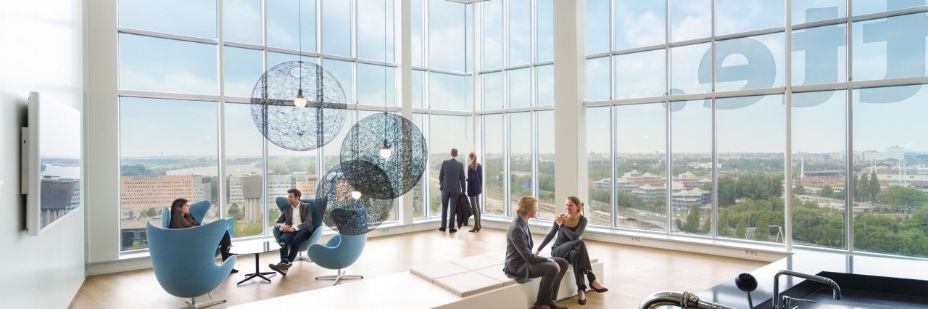
Ubels: Deloitte wanted to develop a new building in Amsterdam, and they asked me to take responsibility for that. Typically, companies like Deloitte are extremely aware of the war to draw talent. We didn't want to build just a regular office but an office that would attract young people to come and work for Deloitte. We imagined that the building would become a very large portion of our identity. We pushed it in every aspect to be the most sustainable — what we could do at that time — and we moved that envelope. We also realized it's not just about the sustainability of the building, but it's also how you go to work, get to work, enjoy work, work with colleagues, get customers over, work with customers. So, we made sure there are all of the amenities you can imagine — top quality coffee, gym, restaurants, food, a convenience shop that you would find in high-end hotels — as well as in the way you could choose a location to work.
What challenges did you face taking The Edge from vision to completion?
That was quite unique when we started thinking about how people would come to the building, how they would park, how they would find the spot, how they would control the light and the temperature. We did not realize that all the things we wanted were simply not there. So today, if you buy a building access system, you know it will work with NFC cards. It will work with your phone if you choose so. But at that time, we had to ask for it, and this is also equally true with license plate registration to get into the parking garage or coffee machines that were connected to the internet. Anything we wanted at that time to be connected; we had to ask for it. Sometimes they even did not have a product that you could connect.
There was a lot of pushback from the building industry, the engineering companies, the actual installers and builders, and that has not changed, unfortunately. That's a huge challenge in the industry; it’s very fragmented. To be honest with you, I'm doing a lot of new buildings, and I still need to push the industry. The real answer to smart buildings is that you buy as much integrated technology upfront. You don't buy separately the revolving door, the turnstiles, the door systems, et cetera. Buy it from one; it makes life 100 times easier.
How has your view on smart buildings changed since The Edge opened more than a decade ago?
The good news is that anything you can buy nowadays has connectivity, so you can connect it to the internet with a cable or wirelessly. That means you can have access to whatever data that system generates. My view on smart buildings has become much broader and much deeper than it has been, and the technology has become cheaper and cheaper. Nowadays, I explain to customers we can build a smart building cheaper than a traditional building, and that is so especially if you buy integrated stuff.
How quickly is the technology landscape changing for buildings? Is AI already playing a role?
Technology itself does not really change that fast because it's a very traditional industry, and they choose not to. The innovation is actually pretty disappointing. Of course, electronics and the embedding of electronics have changed, but the fundamental part of the technology did not change.
There are a tremendous amount of artificial intelligence developments going on. That's good because we can optimize the controls in the systems within the building much better than people can. AI can change the settings of a building automation system and fix it automatically. We can use AI to optimize the heating and the cooling, because most buildings are still pretty stupid in that realm. I mean, how many times do you get into the office on Monday morning and it's still cold in the building? Why? Because somebody decided that the heating is on the clock. I have a philosophy that every single building automation system or control system that still has a clock is old-fashioned because it should learn from behavior.
What upcoming trends or possibilities for smart buildings make you excited about the future?
I've done a couple of buildings in wood construction. I think that's the future. Running them on DC power makes so much sense, and we can do it. The other thing is that we want to make buildings — we're working on it — which we call “function free.” Function free means we do not decide on day one what kind of building it will be. And if you build in wood construction, which is more like a Lego, you can take it apart to repurpose it, which is much easier than when you do it in concrete. Let's say we develop this new structure or building in a city that maybe initially is going to be an office. If you then decide it's going to be an office and you design around the concept of an office, that may limit you from making it a hospital or a school or apartments in the future. I think we should be much more adaptable to the fact that here in the Netherlands, and also in many other places, there's a huge shortage in housing but people are also aging. So, we now have a huge demand for young people for apartments in cities, and we can provide for that. But you can also imagine maybe 20 or 25 years from now we want to get rid of them again.